If you step outside to enjoy a nice afternoon in your yard and are hit with the unmistakable odor of raw sewage, it is impossible to ignore. A healthy septic system should be a closed, odor-free loop. If you smell it, something is wrong.
The Short Answer: A sewage smell in your yard is typically caused by a full septic tank that needs pumping, a failing drain field that can no longer absorb wastewater, a cracked or loose tank lid, or a blocked plumbing vent on your roof.
Let’s break down the four most common reasons your yard smells like sewage and exactly what you need to do to fix the problem before it gets worse.
1. Your Septic Tank is Full
This is the most common—and easiest to fix—reason for a smelly yard. Every time you use water in your home, wastewater flows into your septic tank. Solid waste sinks to the bottom to form sludge, while liquid effluent flows out into the drain field.
Over time, that sludge layer builds up. If you haven’t had your tank pumped in the last 5 to 15 years, the sludge and scum layers may be taking up too much space. When the tank is overfull, the odorous gases have nowhere to go but out through the ground or the nearest vent.
The Fix: Call a professional septic pumper to empty the tank. Once the tank is pumped, start using a monthly bacterial treatment to help break down solid waste more efficiently and extend the time between pump-outs.
2. Your Drain Field is Failing
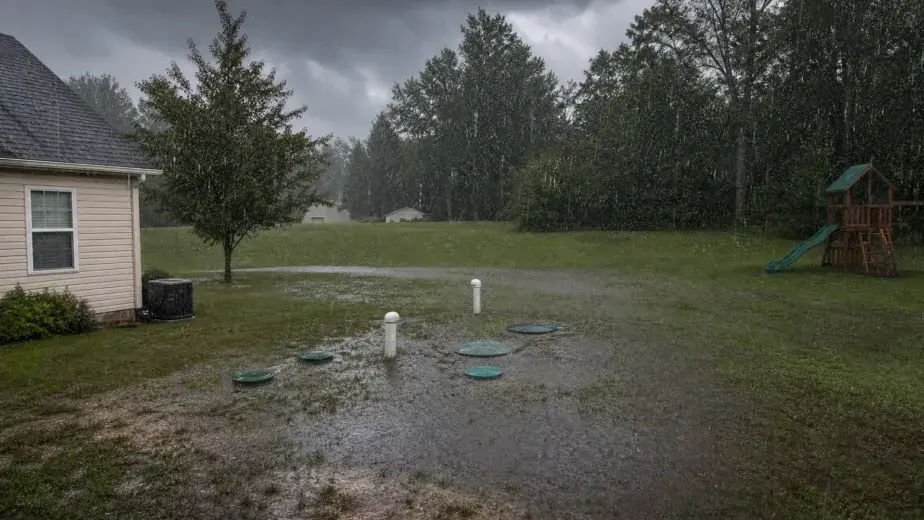
If the smell is concentrated over a specific, large area of your lawn—and especially if the grass in that area is unusually green or the ground feels mushy—your drain field is likely failing.
The drain field is responsible for filtering the liquid wastewater back into the soil. If the soil becomes clogged with solid waste (usually because the tank wasn’t pumped soon enough) or compacted by heavy vehicles, it can no longer absorb liquid. The wastewater then pools just below or directly on the surface of your yard, creating a foul-smelling swamp.
The Fix: This is a serious issue that requires a professional inspection. Stop using excess water immediately to prevent a backup into your home. A professional can determine if the drain field can be restored or if it needs to be replaced.
3. A Loose or Damaged Tank Lid
Septic tanks have access lids (often concrete or heavy plastic) that are removed during pumping. These lids must be completely sealed to prevent toxic and foul-smelling gases—like hydrogen sulfide and methane—from escaping.
If a concrete lid is cracked, or if a plastic riser lid was not screwed down tightly after your last pump-out, those gases will leak directly into your yard.
The Fix: Locate your tank lids. If you see a crack or if the lid feels loose, it needs to be replaced or resealed. Never attempt to open the lid yourself, as the gases inside are dangerous. Have a professional secure or replace the cover.
4. A Blocked Roof Vent
Every house with a septic system has a plumbing vent pipe that sticks out of the roof. This pipe allows sewer gases to escape safely into the air above your home while allowing air into the plumbing lines so water can drain smoothly.
Sometimes, the wind can blow these gases down into your yard. More commonly, the vent pipe can become blocked by leaves, a bird’s nest, or even snow and ice in the winter. When the vent is blocked, the gases are forced out through the path of least resistance—which might be a cleanout pipe in your yard or even the drains inside your house.
The Fix: Have a plumber or a roofer inspect and clear the vent pipe. You can also install an inexpensive charcoal filter on top of the vent pipe to neutralize the odors as they exit.
The Bottom Line
A sewage smell in your yard is your septic system’s way of crying for help. Whether it is a simple fix like a loose lid or a major warning sign of a failing drain field, you should never ignore it. The best way to prevent these odors is through routine pumping and consistent maintenance. By using a natural septic treatment every month, you can keep the bacteria in your tank healthy, reduce odors, and protect your drain field from expensive failures.