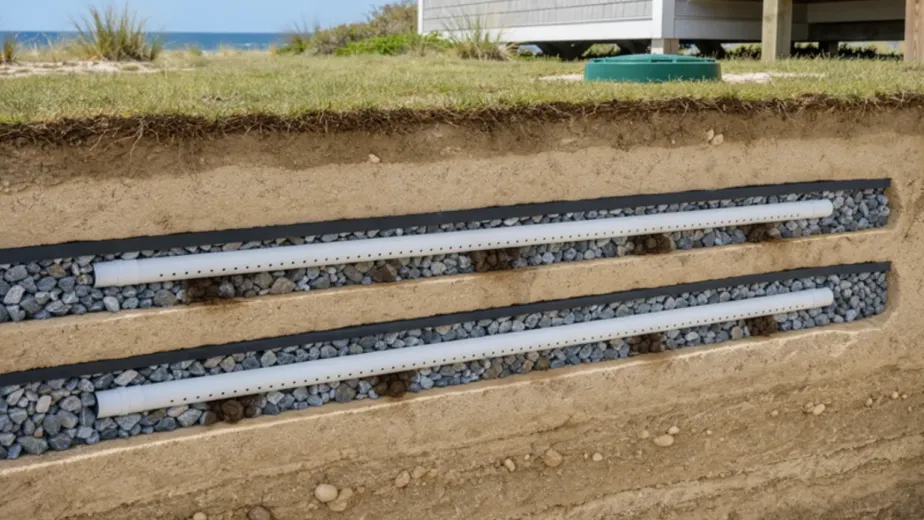
What is a septic distribution box? It is the underground chamber between a septic tank and a drainfield that divides liquid effluent among the drainfield’s distribution pipes. In a conventional gravity system, that even flow helps the soil dispersal area accept wastewater across its designed footprint instead of concentrating the load in one trench. [1] [2]
What does a distribution box do?
A distribution box—often called a D-box—is a small, watertight container, commonly made from concrete or plastic. One pipe brings partially treated wastewater from the septic tank into the box. Several outlet pipes carry it onward to separate trenches, beds, or other drainfield piping. [2]
The box does not replace the septic tank or perform the drainfield’s soil treatment. The tank holds wastewater long enough for heavier solids to settle and lighter material to float. The effluent leaving the tank then travels to the distribution box. In a conventional drainfield, perforated pipes release that effluent into aggregate and soil, where additional physical, chemical, and biological treatment occurs. [1] [3]
A level, intact box is intended to send comparable flow to the connected outlets. If one outlet receives substantially more water, that part of the drainfield can become overloaded while another part is underused. New York’s health department notes that equal flow to each trench helps prevent one section of the absorption field from being overloaded. [4]
Where is the D-box located?
The distribution box is usually underground between the septic tank and the drainfield. Its exact location depends on the permitted design, site layout, and installation history. A property’s “as-built” drawing or septic permit is often the best starting point for finding it; a county or local health department may have those records. [2] [5]
Not every septic system has a distribution box. Some gravity systems use other layouts, and many alternative systems use pumps, manifolds, dosing tanks, or pressure-distribution equipment rather than a simple gravity D-box. The system design—not a generic diagram—determines what components are present. [1] [5]
How does wastewater move through it?
In a gravity system, wastewater moves from the tank through a solid outlet pipe into the box. The box’s outlets lead to the drainfield lines. When the box is properly installed and level, the outlets are set up so incoming effluent can spread across the connected lines rather than favoring one route. [2] [4]
The distribution box is therefore a flow-management point, not a storage tank. It does not make untreated sewage safe, remove accumulated sludge, or correct an undersized, saturated, damaged, or poorly sited drainfield. Its performance depends on the entire system: a watertight tank and pipes, appropriate hydraulic design, functioning outlets, and soil that can accept the wastewater.
Some systems use pressure distribution. In those systems, a pump may dose wastewater through a manifold or other equipment, and the layout can differ from a gravity D-box. EPA explains that alternative systems may require pump tanks, electrical power, controls, and additional maintenance. [1] Do not assume that a visible box or access cover identifies the whole system.
Why does a distribution box matter?
The D-box affects how evenly the drainfield is used. Even loading gives the soil dispersal area a better chance to accept effluent across its intended area. Uneven loading can contribute to ponding or premature stress in one portion, although those symptoms can also have many other causes.
The box also provides an important diagnostic point during a professional inspection. EPA says a typical septic inspection may include opening and inspecting the distribution box, examining its structural integrity, and checking whether drain lines are receiving equal flow. [2] A cracked box, leaking joint, blocked outlet, displaced pipe, or box that is no longer level can alter flow and needs evaluation in the context of the complete system.
A D-box problem is not automatically a failed drainfield. Conversely, correcting a box does not guarantee that a drainfield will recover. A professional should assess the tank, effluent filter if present, pipes, box, pumps and controls where applicable, drainfield, soil, and site drainage before identifying the cause of a problem.
What are common signs of a D-box or drainfield problem?
Homeowners usually cannot diagnose a distribution box from indoor plumbing symptoms alone. Slow drains, gurgling, sewage odors, wet spots, standing water, or sewage backing up can indicate a septic malfunction, but they can also result from a blocked building sewer, a full tank, a pump or electrical failure, or a drainfield problem. EPA lists backups, slow fixtures, odors, and wet or spongy areas as warning signs that warrant professional attention. [2]
Unevenly wet areas over separate drainfield lines may be a useful clue, but they are not proof that the D-box is the cause. Keep vehicles, structures, and heavy equipment off the septic system and drainfield, and keep roof runoff and sump discharge from flowing onto the system. Excess water can interfere with drainfield function, while traffic can compact soil or damage components. [3] [4]
Can a homeowner inspect a distribution box?
Treat a distribution box as part of a wastewater system, not as a routine yard access point. Washington State’s inspection guide says not all D-boxes are accessible, advises checking the as-built drawing, and does not recommend that homeowners dig one up. It directs homeowners to stop and contact a professional when the box has clogs, cracks, leaks, or apparently uneven flow. [5]
Never enter a septic tank, pump chamber, distribution box, or other confined space. Do not reach into wastewater or handle electrical equipment. If a cover is damaged, buried, unstable, or difficult to lift, leave it alone and contact a qualified septic professional or local health department. A professional can locate and expose the component safely, check levels and connections, and determine whether local permits or requirements apply to a repair or riser.
How do you protect the distribution box and drainfield?
The most useful protection is routine whole-system care:
- Keep accurate records and retain the system design, permit, and as-built drawing.
- Have the system inspected and the tank pumped on a schedule appropriate for the system, household, and local requirements. EPA describes inspections every one to three years and pumping commonly every three to five years, but local rules and actual solids accumulation control. [2]
- Keep heavy vehicles, construction, and permanent structures away from the septic components and absorption area. [4]
- Direct roof, foundation, and surface runoff away from the system. [3] [4]
- Flush only human waste and toilet paper, and avoid sending grease, chemicals, wipes, and other non-degradable materials into the system. [2] [4]
- Do not rely on additives or treatments to repair a structural, hydraulic, mechanical, or drainfield failure. A malfunction requires diagnosis and, where needed, repair by a qualified professional.
If sewage backs up into the home, avoid contact with it and arrange qualified cleanup and septic or plumbing help. Wastewater can contain pathogens, and electrical or pump problems require trained handling. [2]
The Bottom Line
A septic distribution box is the junction that directs septic-tank effluent into multiple drainfield lines. Its job is simple but important: help distribute flow across the designed absorption area. It is only one part of a system, and a damaged or uneven box can be a symptom—or a contributor—to a larger problem. Use the permit or as-built drawing, avoid unsafe access, and have a qualified professional inspect the system when flow, odors, wet areas, backups, or structural concerns appear.
References
[1] Types of Septic Systems: https://www.epa.gov/septic/types-septic-systems
[2] Resolving Septic System Malfunctions: https://www.epa.gov/septic/resolving-septic-system-malfunctions
[3] Understanding Your Septic System and How It Works: https://extension.umd.edu/resource/understanding-your-septic-system-and-how-it-works
[4] Septic System Operation and Maintenance: https://www.health.ny.gov/publications/3208/
[5] Do-It-Yourself Septic System Inspection Field Guide: https://doh.wa.gov/sites/default/files/legacy/Documents/Pubs/337-121.pdf