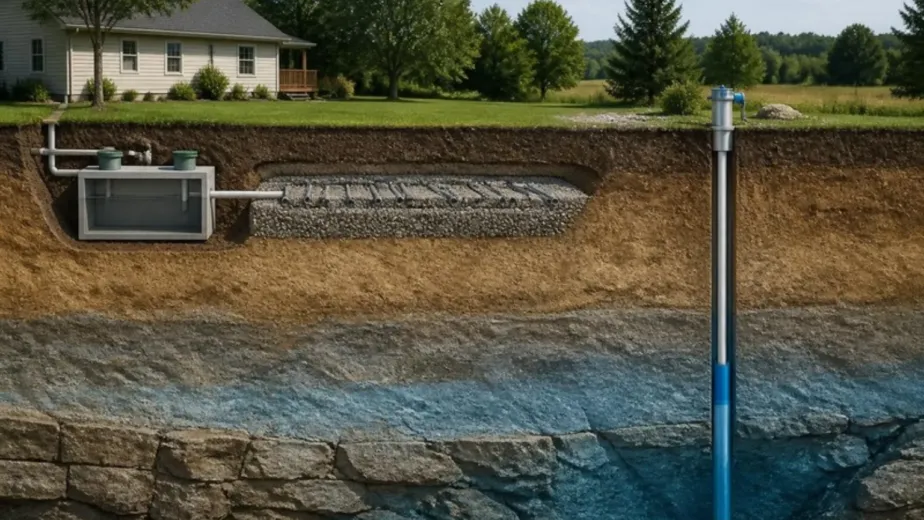
Yes, a septic tank can crack, leak, or otherwise lose its structural integrity. If you are asking can a septic tank crack, the practical answer is to treat visible damage, an unusually low liquid level, sewage odors, or wet ground as reasons to stop guessing and arrange a qualified inspection. A crack is not something a drain treatment or routine pumping can repair.
What can make a septic tank crack?
A tank can be damaged by age, material deterioration, soil movement, heavy loading above it, poor installation, or flooding. The cause depends on tank material and site conditions, so a homeowner should not assume every visible line is a structural crack.
Concrete tanks may develop damage at walls, floors, covers, seams, or pipe penetrations. A damaged baffle, lid, or inlet or outlet connection can also create a leak without a crack through the tank. The University of Rhode Island’s pump-out guidance tells service professionals to look for cracks, a leaking mid-seam, an open weep hole, and damaged baffles after emptying the tank. [1]
Flooding deserves special attention. Saturated soil can prevent a system from working normally, and the Centers for Disease Control and Prevention warns that a septic tank can collapse or float out of position during flooding. [2] A tank that shifts can strain connected pipes and joints even when the original problem was not a crack. Keep vehicles, heavy equipment, additions, and other loads off the tank area unless a qualified professional has confirmed that the installation is designed for them.
What are the signs of a cracked or leaking tank?
Look for clues around the tank and across the whole system:
- An unusually low liquid level after the tank has been used normally. URI notes that a liquid level below the outlet pipe usually indicates a tank leak, while a level above the outlet can point to a downstream pipe or drainfield problem. [1]
- Wet, spongy, or unusually lush ground near the tank. Surface moisture can indicate leakage, but it can also come from a failing or saturated drainfield. [3]
- Sewage odors near the tank or drainfield. Odor is a warning, not a diagnosis; EPA notes that venting conditions, blocked vents, and drainfield problems can also cause smells. [4]
- Slow drains, gurgling, or sewage backing up into toilets, sinks, showers, or tubs. These are signs of a malfunctioning septic system, but they can also result from a clogged house-to-tank pipe, a blocked baffle or effluent filter, a full tank, or a failed drainfield. [3] [4]
- Visible settlement, a displaced cover, or a depression over the tank. These conditions warrant prompt professional attention because they may indicate movement or a safety hazard, even if they do not prove the tank shell is cracked.
A cracked tank is only one possible explanation. For example, a slow drain can originate in the house plumbing, while a high liquid level can reflect a blocked outlet or drainfield. Diagnosis requires checking the tank, its inlet and outlet, connected pipes, pump components where present, and the drainfield—not just looking at one symptom.
Is a cracked septic tank an emergency?
Treat active sewage surfacing, a plumbing backup, a collapsing or unsafe cover, or suspected flood damage as urgent. Untreated sewage can carry pathogens and contaminate soil, groundwater, surface water, or a private well. [3] Keep children and pets away from wet or sewage-affected areas, limit water use if wastewater is backing up, and contact a septic professional or local health department.
Do not open a tank casually, lean into it, climb down, or enter it. Septic tanks contain poisonous gases, germs, and other hazards; NC State Extension states that no one should ever enter a septic tank. [5] Do not touch pump controls or electrical equipment that may be wet. If wastewater has entered the home, avoid contact and follow public-health guidance for cleanup. [4]
How is a cracked tank diagnosed?
Gather your property’s septic permit, as-built drawing, pumping records, and prior inspection reports. EPA says local health or environmental departments typically keep permit and design records and can help identify local professionals. [6]
A qualified inspector or septic service professional may:
- Locate and safely expose the tank access points without damaging the system.
- Review the liquid level and evidence of leakage or backup.
- Pump the tank when appropriate, then examine the empty tank for cracks, leaking seams, damaged baffles, and other structural defects.
- Check inlet and outlet pipes, the effluent filter if installed, and the distribution box.
- Inspect pumps, floats, alarms, controls, and wiring on systems that use electrical components.
- Evaluate the drainfield and, when needed, use cameras or additional testing to assess connected piping.
EPA describes a typical inspection as an evaluation of the tank’s integrity, pipes, electrical components, possible blockages, and drainfield performance. [4] Ask the professional to document the location and extent of any crack, whether the tank is leaking, whether wastewater is escaping, and whether the defect affects structural safety or only watertightness.
Can a cracked septic tank be repaired?
Sometimes a professional can repair a limited defect; in other cases, the tank, cover, connected piping, or part of the septic system must be replaced. The decision depends on the tank’s material, age, location and size of the damage, structural condition, access, groundwater and soil conditions, and local requirements. There is no reliable homeowner test that can determine whether a crack is safe to seal.
Do not pour acids, solvents, “sealers,” or other chemicals into the tank as a do-it-yourself fix. URI warns that acids can destroy a concrete tank and that chemical additives do not replace pumping or correct system failures. [1] A treatment product cannot rebuild a cracked wall, stabilize a shifted tank, repair a broken pipe, or restore a failed drainfield.
Before excavation or replacement, contact the local permitting authority. EPA explains that individual onsite wastewater systems are regulated primarily by states, tribes, and local governments, and that a permit from the local authority is generally required for repair, new construction, or replacement. [6] Requirements vary, so do not rely on a generic online repair method or an assumed setback.
What should you do now?
If you suspect a crack:
- Keep people and pets away from exposed lids, depressions, standing water, and sewage.
- Reduce unnecessary water use if drains are backing up or wastewater is surfacing.
- Do not enter the tank or pump chamber and do not attempt electrical or structural work.
- Call a qualified septic professional for a documented inspection. Contact the health or environmental department for local permit and contractor information.
- Ask for a written scope of work that separates tank damage from pipe, pump, baffle, and drainfield problems.
- Follow required permits and repair approvals before excavation, sealing, replacement, or abandonment.
The Bottom Line
A septic tank can crack, leak, shift, or fail at a seam or connection. Wet ground, odors, backups, and an abnormal tank liquid level are useful warnings, but none proves the cause by itself. Stay out of the tank, protect people from sewage and unsafe covers, and have a qualified professional inspect the complete system. A structural defect needs an appropriate repair or replacement—not a chemical treatment.
References
[1] Septic Tank Pump-Out, University of Rhode Island Cooperative Extension: https://web.uri.edu/owt/wp-content/uploads/sites/2062/PumpoutPgdFS.pdf
[2] Guidelines for Septic and Onsite Wastewater Systems, Centers for Disease Control and Prevention: https://www.cdc.gov/floods/safety/guidelines-for-septic-and-onsite-wastewater-systems.html
[3] Signs of Septic System Failure, Washington State Department of Health: https://doh.wa.gov/community-and-environment/wastewater-management/septic-system/signs-failure
[4] Resolving Septic System Malfunctions, U.S. Environmental Protection Agency: https://www.epa.gov/septic/resolving-septic-system-malfunctions
[5] Septic System Owner’s Guide, NC State Extension: https://content.ces.ncsu.edu/septic-system-owners-guide
[6] Frequent Questions on Septic Systems, U.S. Environmental Protection Agency: https://www.epa.gov/septic/frequent-questions-septic-systems