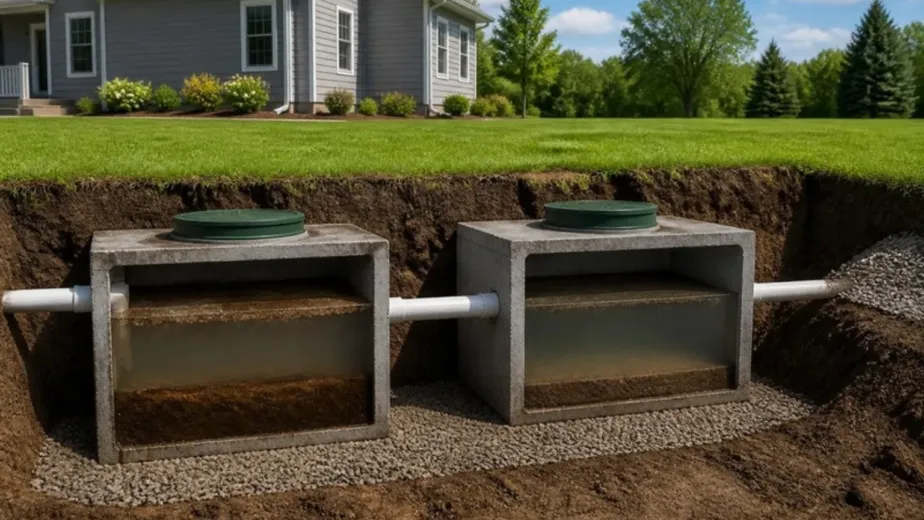
Yes—a septic system can work in sandy soil, but the site must be evaluated and the system designed for how quickly that soil moves water. The phrase septic system sandy soil does not describe a simple yes-or-no condition. Some sand accepts effluent so quickly that wastewater may not receive enough treatment before reaching groundwater; other sites have a seasonal water table, a finer layer, or a gravelly layer that changes how the system behaves. A qualified designer must evaluate the actual soil profile, not just the soil visible at the surface.
Why is sandy soil both helpful and challenging?
A conventional septic system depends on the soil beneath the drainfield. The tank settles solids and separates scum, but liquid effluent still needs to pass through soil for additional treatment and dispersal. In that soil, physical, chemical, and biological processes reduce many contaminants before the water reaches groundwater. [1]
Sand has relatively large pores, so water generally moves through it faster than through clay. That can make sand easy to excavate and able to accept wastewater. But speed is the central concern: if effluent travels too quickly, the soil may not provide enough contact time for treatment. University of Minnesota Extension explains that soil texture helps estimate water movement, but texture alone is not enough to set a system’s loading rate or design. [2]
Very sandy soil is therefore not automatically “good drainage.” Rapid movement can increase the risk that pathogens or nutrients travel toward groundwater, especially where the drainfield is near a drinking-water well, stream, lake, or coastal water. The U.S. Environmental Protection Agency notes that groundwater beneath a drainfield can carry remaining contaminants toward surface water and advises checking local requirements for setbacks; in sandy or porous soil, a greater separation from surface water may be appropriate. [3]
Does a perc test prove sandy soil is suitable?
No. A percolation test is one piece of a site evaluation, not a universal approval. The test measures how quickly water drops in a prepared hole, but the result does not describe every condition that affects wastewater treatment. Local rules may use percolation results in different ways, and some jurisdictions rely more heavily on professional soil descriptions, hydraulic loading rates, or other tests.
A complete evaluation should consider soil texture and structure at the proposed drainfield depth, limiting layers, seasonal saturation, groundwater, slope, available area, and nearby wells or surface water. Ohio State University Extension identifies soil that is saturated for part of the year, as well as layers that transmit water either too slowly or too rapidly, as potential limiting conditions. It also explains that a site’s soil depth helps determine what type of treatment system can be used. [4]
Do not assume a dry-season inspection proves that the site stays unsaturated. An evaluator looks for evidence of seasonal saturation in the soil profile, including changes in soil color. [4] Your county or state health department can tell you which evaluation, permit, and designer credentials apply where you live.
Can a conventional drainfield be installed in sand?
Sometimes. If the soil profile, groundwater separation, loading rate, and other local criteria are acceptable, a properly designed conventional system may be possible. The design must account for the soil beneath the distribution area, not merely the sand used as fill or the material brought to the property. Poorly placed fill, compacted soil, abrupt texture changes, or a shallow limiting layer can change water movement and treatment.
The drainfield also needs protection after installation. Heavy equipment, vehicles, structures, and concentrated runoff can compact or saturate the soil. Compaction changes pore spaces and can reduce the soil’s ability to accept effluent. [2] Keep roof drainage, sump-pump discharge, and other clean-water flows away from the drainfield so the field is not asked to handle water it was never designed to receive.
Drainfield size is not something a homeowner should estimate from the sand alone. It depends on factors such as expected wastewater flow, bedrooms or design occupancy, soil characteristics, and local code. Nebraska Extension describes percolation rate as a factor used in drainfield sizing and warns that extremely rapid movement can prevent adequate treatment. [5] Use the approved site plan and local authority’s requirements rather than a generic online sizing chart.
What if the sand is too fast or groundwater is too shallow?
A site that is unsuitable for a standard system may still have engineered options, depending on local approval and the site’s constraints. EPA lists alternatives such as mound systems, pressure or drip distribution, aerobic treatment units, and sand filters. Mound systems can be used in some areas with shallow soil, high groundwater, or shallow bedrock; they place a designed sand layer and drainfield above or partly above native ground and commonly use a pump chamber. [6]
Those options are not interchangeable do-it-yourself upgrades. They can require pumps, controls, electrical work, alarms, additional treatment, continuing inspections, or more involved maintenance. EPA specifically notes that alternative systems vary in their components and maintenance needs. [6] A licensed or otherwise qualified local professional should match the system to the evaluated soil and the applicable permit conditions.
Do not “fix” a rapid-percolation site by casually adding sand, gravel, or soil. A change in soil layers can redirect effluent, reduce treatment, or violate the approved design. Any modification should be evaluated and permitted by the responsible local authority.
How should a homeowner protect a septic system in sandy soil?
Start with the site records. Keep the permit, as-built drawing, soil or site evaluation, tank location, drainfield boundaries, and maintenance history together. If you are buying property, ask for these records and arrange an inspection by a qualified septic professional before relying on the system.
Use water thoughtfully. Spread laundry across the week, repair plumbing leaks, and avoid sending large surges of water to the drainfield. Do not flush wipes, grease, medications, harsh chemicals, or other materials that can interfere with treatment or add unnecessary solids. Follow your local authority’s pumping and inspection schedule; pumping intervals depend on the tank, household, and use, so there is no universal calendar that fits every home.
Watch for warning signs: sewage odors, unusually wet or bright-green areas over the field, slow drains, gurgling, sewage surfacing, or backups. A backup or sewage exposure is a health hazard. Keep people and pets away from wastewater, and call a qualified septic or plumbing professional. Never enter a septic tank, pump chamber, or other confined space. Electrical controls, pumps, structural damage, and wastewater-contact cleanup also require trained professionals.
If a system is already failing, soil amendments or biological treatments cannot repair a failed drainfield, remove roots, restore collapsed or clogged components, replace pumping, or correct a mechanical or structural defect. Stop using excess water and obtain a professional diagnosis. Repairs, replacement, or an alternative design may be required under local rules.
The Bottom Line
A septic system can work in sandy soil when the soil profile and groundwater conditions provide adequate treatment and the system is designed, installed, and maintained for the site. Sand’s rapid drainage is both an advantage and a risk. Have the site evaluated by qualified professionals, follow the local health department’s requirements, protect the drainfield from extra water and compaction, and treat backups or surfacing sewage as urgent repair issues—not as problems a household treatment can solve.
References
[1] How Septic Systems Work: https://www.epa.gov/septic/how-septic-systems-work
[2] The impact of soil texture on system installation: https://septic.umn.edu/news/soil-texture
[3] Septic Systems and Surface Water: https://www.epa.gov/septic/septic-systems-and-surface-water
[4] Soil Evaluation for Home Septic Systems: https://ohioline.osu.edu/factsheet/aex-742
[5] Drainfield Size & Design: https://water.unl.edu/article/wastewater/drainfield-size-design/
[6] Types of Septic Systems: https://www.epa.gov/septic/types-septic-systems