You’re mowing the lawn on a sunny, dry afternoon, and suddenly your boots sink into a patch of wet, squishy grass. If it hasn’t rained in days, and that spongy spot is located over your septic system, you need to stop the mower and investigate immediately.
The Short Answer: A wet, mushy spot over your drain field or septic tank is a major warning sign that your system is failing. It means the soil can no longer absorb the liquid wastewater (effluent) exiting the tank, causing it to pool on or just below the surface of your yard.
Let’s look at exactly why this happens, how to confirm it’s a septic issue, and what you need to do to fix it before sewage backs up into your home.
The Role of the Drain Field
To understand why your yard is wet, you have to understand how your septic system disposes of water.
When wastewater leaves your house, it enters the septic tank. The heavy solids sink (sludge), the fats and oils float (scum), and the relatively clear liquid in the middle (effluent) flows out into the drain field.
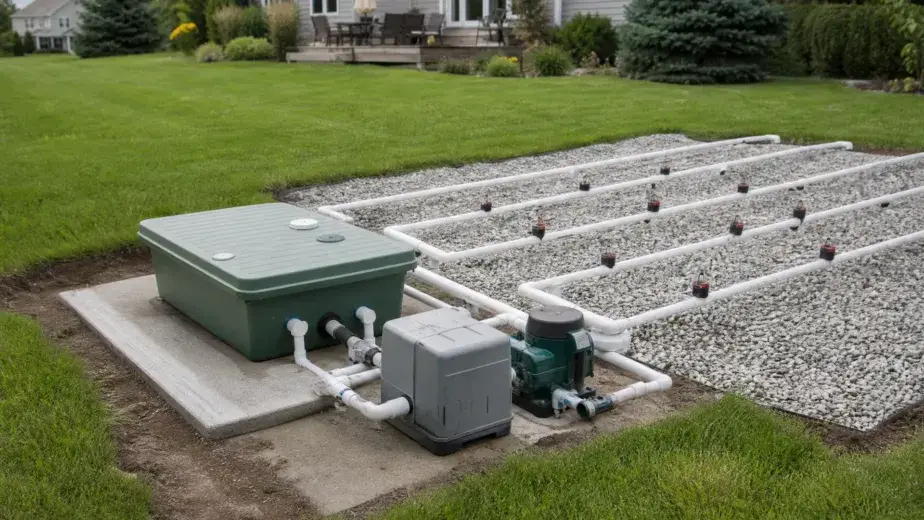
The drain field is a network of perforated pipes buried in trenches filled with gravel. The effluent slowly trickles out of these pipes and percolates down into the soil, which acts as a massive natural filter. By the time the water reaches the groundwater table, it is clean.
Why Does the Drain Field Fail?
A healthy drain field should last 20 to 30 years. However, it can fail prematurely if the soil becomes clogged or compacted. When the soil can no longer absorb the effluent, the water has nowhere to go but up to the surface.
Here are the three most common reasons your drain field is failing and causing mushy spots:
1. You Waited Too Long to Pump the Tank
This is the number one cause of drain field failure. If you don’t pump your septic tank every 3 to 5 years, the sludge layer at the bottom gets too high. Eventually, that thick, solid waste is pushed out of the tank and into the perforated pipes of the drain field.
The sludge permanently clogs the pores of the soil in the trenches. Once the soil is clogged with solid waste, it becomes impermeable. The effluent pools in the trenches and eventually rises to the surface of your lawn.
2. You Used Too Much Water
Your septic system is designed to process a specific number of gallons per day. If you do six loads of laundry on a Saturday, take four long showers, and run the dishwasher twice, you are flooding the tank.
This massive surge of water pushes the effluent out into the drain field faster than the soil can absorb it. If you continually overload the system, the trenches will stay flooded, and the yard will become permanently mushy.
3. You Compacted the Soil
The soil over your drain field needs to be loose and oxygen-rich to filter water properly. If you drive a heavy truck over the area, park a car there, or build a patio or shed on top of it, you crush the perforated pipes and compact the soil. Compacted soil cannot absorb water, leading to immediate pooling on the surface.
How to Confirm It’s a Septic Issue
Before you panic, make sure the wet spot isn’t caused by something else.
- Check the Weather: Has it rained heavily recently? Is the spot in a natural low point where runoff collects?
- Check for Leaks: Is a garden hose leaking? Is a sprinkler head broken? Is your sump pump discharging in that area?
- Smell It: This is the most unpleasant but definitive test. If the mushy spot smells like raw sewage or a foul, sulfurous odor, it is almost certainly effluent from your septic system.
- Look at the Grass: Effluent is rich in nutrients (nitrogen and phosphorus). If the grass in the mushy spot is significantly greener, taller, and growing faster than the rest of the lawn, it is being fertilized by wastewater.
What to Do Next
If you confirm the mushy spot is over your drain field and smells like sewage, you are facing a serious problem.
Action 1: Stop using all unnecessary water in the house immediately. Do not run the washing machine or dishwasher. Every gallon you put down the drain is another gallon pooling in your yard or preparing to back up into your bathtub.
Action 2: Call a licensed septic professional. They will need to inspect the tank levels, check the outlet baffle, and evaluate the condition of the drain field.
Action 3: You will likely need an emergency pump-out to relieve the pressure on the system. Depending on the severity of the clog, the professional may be able to jet the lines or use specialized treatments to restore the soil. In the worst-case scenario, the drain field will need to be replaced.
The Bottom Line
A wet, mushy, foul-smelling spot in your yard is your drain field waving a white flag. It means the soil is clogged or saturated and can no longer filter wastewater. The only way to prevent this expensive nightmare is to pump your tank every 3 to 5 years, conserve water, and use a monthly bacterial treatment like a high-quality bacterial treatment to keep the solid waste in the tank broken down efficiently.